
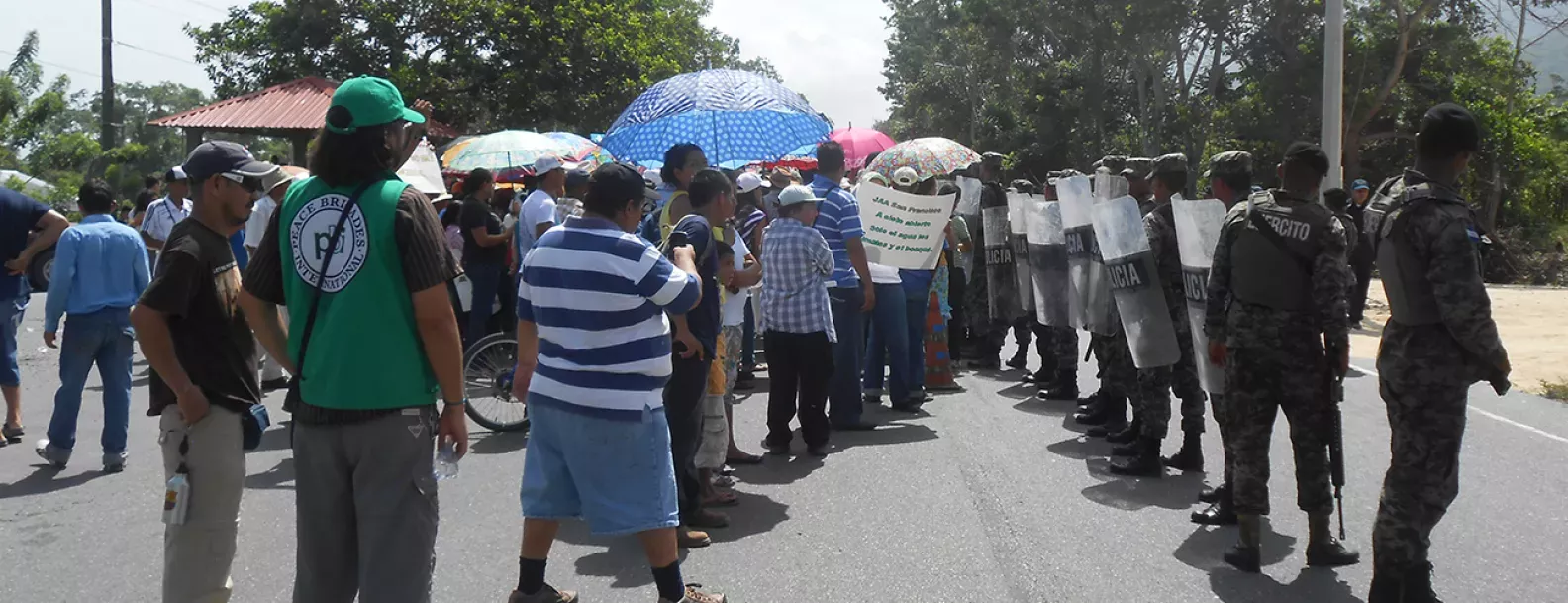
Since the 2009 coup in Honduras, Peace Brigades International (PBI) has observed with growing concern that the situation of human rights defenders in the country continues to deteriorate. Due to the high level of violence that occurs on a daily basis, the country is now considered one of the most dangerous in the world. In addition, there is no effective legal system in place, allowing corruption and criminal structures to flourish. All of this leads to daily human rights violations.
In May 2010, PBI received a request for support from the Honduran Human Rights Coordination Group (Plataforma de Derechos Humanos de Honduras), a network consisting of six of the most important organizations working to defend human rights in the country. In response to this request, PBI activated its response protocol, which led to the following phases of the PBI project in Honduras:
Exploration: 2011–2012
Decision and opening: 2013–2014
Establishment and consolidation: 2015–2018
PBI Honduras currently accompanies a wide range of organizations working to defend human rights, land and territory protection, environmental rights, and the rights of indigenous groups and the LGBTQ+ community. These are actors who fight against harmful extractive projects, work to promote food and land sovereignty, protect journalists, and advocate for equality and sexual diversity. These partners include ARCAH, Arcoíris, ASODEBICOQ, ASOPODEHU (Dina Meza), CEHPRODEC, CNTC, COPINH, and SOMOS CDC, organizations that together reflect the broad social and human rights struggle in Honduras.
Goal
PBI Honduras accompanies and strengthens the work of human rights defenders, social movements, and local initiatives at risk, with the aim of contributing to the guarantee and respect of fundamental rights in the country.
Objectives
- Promoting comprehensive protection strategies for human rights defenders.
- To combat criminalization and impunity that undermine the legitimate work of defenders.
- To reduce the negative effects of private interests and increasing restrictions on defending land, territory, and the environment.
To achieve these objectives, PBI Honduras maintains a field team in Tegucigalpa, which provides international accompaniment to human rights defenders in different parts of the country. In addition, the project has staff who support the various areas of work, both inside and outside Honduras.
The national PBI groups play a key role in international advocacy and fundraising, enabling PBI Honduras to continue to function as a sustainable project.